Nigeria Needs 800,000 Police Officers: Practical Solutions to Nigeria’s Security Challenges

This is not a news report, nor is it intended to be an academic or research paper. It is a practical policy proposal aimed at providing creative, realistic, and customized solutions to Nigeria’s security challenges. The primary responsibility for protecting lives and property within Nigeria’s territory rests with the Nigeria Police Force, supported by other sister security agencies according to their respective mandates. While the military and other security agencies have important roles to play, effective internal security ultimately requires a police force with sufficient personnel, adequate training, appropriate equipment, and the capacity to maintain a meaningful presence within communities.
One of the most fundamental challenges confronting the Nigeria Police Force is inadequate manpower. Effective policing requires enough properly trained personnel to cover communities, respond to emergencies, gather intelligence, prevent crime, and maintain a visible security presence. Where the number of personnel is grossly inadequate, even well-designed security policies can struggle to produce meaningful results. (Sources: Riples Nigeria, Channels)
Insecurity in Nigeria, as in parts of Africa and the Sahel, is driven by several factors, including armed robbery, banditry, kidnapping for ransom, terrorism, communal violence, and other forms of organized crime. However, one common problem cuts across many of these threats: the state often lacks sufficient security personnel to maintain effective coverage across its vast territory.
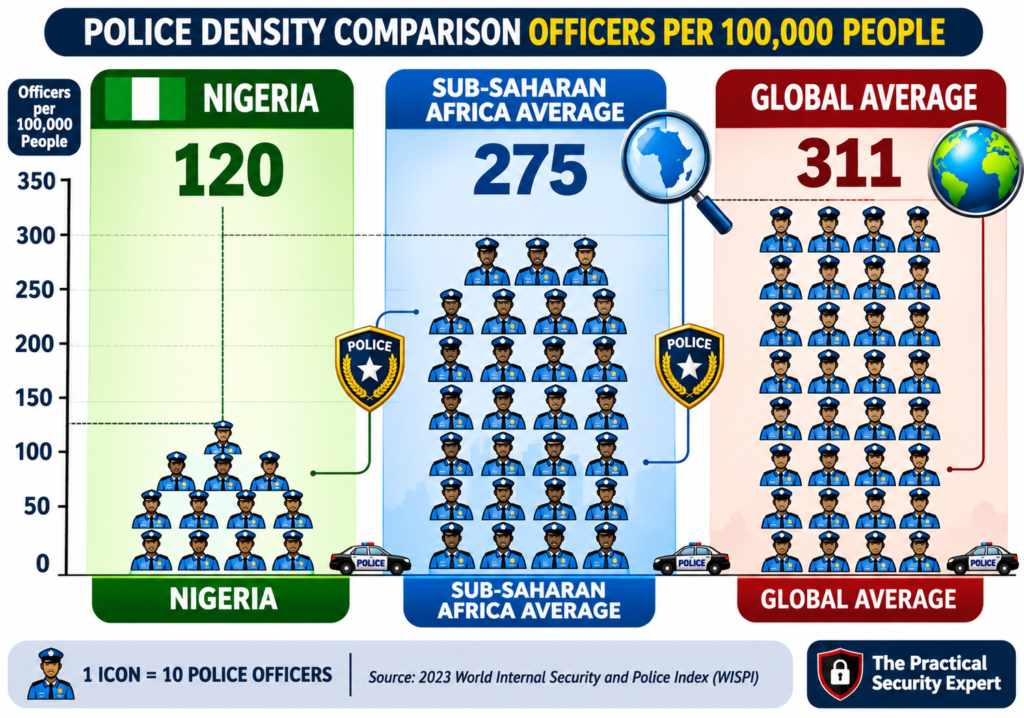
A community cannot be considered adequately protected simply because it has a police station or a handful of officers. Security presence must be meaningful enough to deter potential offenders, detect emerging threats, respond to distress calls, and provide assistance before an incident escalates. This is why Nigeria must treat police manpower as a strategic national security requirement, rather than merely an administrative staffing issue.
Where sufficient personnel cannot be permanently stationed in every community, the alternative should be to establish strategically positioned, highly mobile response teams capable of reaching surrounding communities within a reasonable response time. Such teams should be supported by effective communication systems, intelligence, mobility, surveillance technology, and clearly defined reinforcement arrangements. Political meetings, security summits, military operations, negotiations, regional cooperation, intelligence initiatives, and public appeals all have important roles in addressing insecurity. However, none of these can completely substitute for adequate security personnel on the ground.
The fundamental principle is straightforward: You cannot effectively police a population that you do not have enough personnel to cover.Nigeria therefore needs a deliberate strategy to recruit more police personnel, train them properly, deploy them intelligently, and create a multilayered system in which local, regional, state, and federal security formations can rapidly reinforce one another. The solution is not simply to put more officers on the payroll. It is to build a police structure in which every community has access to a credible security presence and every distress call can trigger a rapid and proportionate response
Current Number of Police Personnel in Nigeria
Determining the exact current number of police personnel in Nigeria is difficult because publicly available figures are inconsistent, and the Nigeria Police Force does not appear to maintain a publicly accessible, continuously updated personnel register showing its precise operational strength. This makes it difficult to establish a definitive figure without access to current official personnel records.
A figure of approximately 371,800 police personnel as at late 2025 is sometimes cited in public discussions, However, these figures should be treated as estimates rather than independently verified current figures from an official personnel register. (Sources: Dataphyte, Global Fire Power)
The purpose of this article is not to establish the precise current strength of the Nigeria Police Force. Rather, it is to examine whether Nigeria has sufficient policing capacity to effectively protect its rapidly growing population and respond to the country’s security challenges. Even without establishing the exact number, there are strong indications that police manpower remains inadequate. Successive leadership of the Nigeria Police Force and the Police Service Commission have repeatedly advocated increased recruitment and improved policing capacity. Even without establishing the exact number, there are strong indications that police manpower remains inadequate. Successive leadership of the Nigeria Police Force and the Police Service Commission have repeatedly advocated increased recruitment and improved policing capacity.
In 2025, then Inspector-General of Police Kayode Egbetokun, who served from 2023 to 2026, reportedly stated that Nigeria required approximately 190,000 additional police personnel to improve the police-to-population ratio toward the often-cited benchmark of one police officer to 460 people. (Source: Channels). If that additional requirement is added to a police strength of approximately 371,800, it would imply a force of roughly 561,800 personnel under that particular calculation.
Reality of Nigeria’s Security Situation and Why Effort to Tackle Insecurity Appeared to be Ineffective
1. Armed Groups Attacks In large number most times significantly outnumbering security personnel on ground.
In many attacks, armed groups may operate in significant numbers and may possess greater mobility and firepower than the security personnel immediately available at the scene. When a small number of officers are confronted with a much larger attacking force and reinforcement is several hours away, the situation becomes extremely difficult to control.
This helps explain why members of the public sometimes perceive security responses as reactive rather than preventive. Security personnel arrive after an incident has occurred because there was insufficient capacity to maintain a continuous protective presence or respond quickly enough to prevent the attack.
2. Response Time Is Too Long—Long Enough for Attackers to Commit Atrocities and Escape
One of the clearest indicators of policing effectiveness is response time—the length of time between the moment a distress call is received and the arrival of police personnel at the scene. Although response time is a reactive measure because a distress call usually means that a crime or security incident has already begun, it remains a critical component of effective policing.
Modern policing should not focus primarily on responding to crimes after they occur. The ultimate objective should be prevention: identifying threats early, deterring potential offenders, and preventing attacks before they take place. However, when prevention fails, the ability to respond rapidly can determine whether an incident is contained quickly or develops into a major tragedy.
In Nigeria, police response times can be affected by several factors, including inadequate manpower, poor communication systems, insufficient patrol vehicles and other logistics, difficult terrain, inadequate intelligence, and the distance between police formations and vulnerable communities.
The consequence can be devastating. When security personnel are located too far from communities, or when available personnel cannot mobilize quickly, attackers may have sufficient time to carry out an attack, inflict casualties, abduct victims, destroy property, and escape before security forces arrive. This creates a dangerous cycle: security forces arrive after the perpetrators have already achieved their objective, while communities lose confidence in the ability of the state to protect them.
Therefore, improving response time should be treated as a national security priority. Police formations should be positioned strategically based on population, geography, crime patterns, and threat levels. Rapid-response units should be adequately equipped and supported by reliable communication systems, mobility, intelligence, and appropriate surveillance technology.
The goal should not simply be to make the police faster at responding to crimes. The broader objective should be to establish a security architecture in which threats are detected early, preventive action is taken whenever possible, and when an incident occurs, sufficient personnel are close enough to intervene before attackers can achieve their objectives and escape. A response that arrives after the attackers have completed their mission may be a response—but it is not effective and perhaps useless to the victim.
3. Displacement of attacks rather than preventing attacks
There is a fundamental difference between preventing an attack and displacing an attack. Attack prevention involves developing and implementing a coordinated system of effective security strategies, intelligence mechanisms, operational structures, and resource allocations designed to protect an entire geographical area, whether a local government area, a state, or the nation as a whole. The objective is to identify, deter, disrupt, and neutralise potential threats before they materialise, without creating security vulnerabilities in other locations.
Attack displacement, on the other hand, occurs when security personnel, operational resources, and military assets are withdrawn from one location and redeployed to another perceived to be under an immediate security threat. Although such deployment may temporarily strengthen security in the receiving location, it can expose the location from which personnel were withdrawn to increased vulnerability. In this circumstance, the security threat is not necessarily eliminated; rather, the conditions that make an attack possible may simply be transferred from one location to another.
This distinction is particularly important in the management of security threats across vulnerable communities, where the redeployment of security personnel without adequate replacement arrangements, risk assessment, and intelligence coordination can create operational gaps that criminal groups may exploit.
On 17th November 2025, armed bandits attacked Government Girls Comprehensive Secondary School, Maga, in Kebbi State, abducting 25 schoolgirls. The incident reportedly occurred in the early hours of the morning, around 3:45 a.m., local time. (Source: BBC)
Following the incident, reports emerged that the state governor had received intelligence indicating a possible attack on the school. In response to the intelligence, a security meeting was reportedly convened, during which Nigerian Army personnel were deployed to provide security for the school and prevent the anticipated attack.
However, accounts of the incident subsequently indicated that the troops assigned to protect the school had withdrawn around 3:00am and the attackers arrived by 3:45am. Reports concerning the circumstances surrounding their withdrawal were conflicting. One account suggested that the troops had been redeployed to another location following what was believed to be a diversionary operation by the bandits. Another account maintained that no redeployment order had been issued and that the soldiers who were on duty had been detained pending an investigation to establish the circumstances surrounding the incident. (Source: Premium Times)
If the account of an authorised redeployment is established to be accurate, the incident would illustrate the concept of attack displacement rather than attack prevention. In other words, an attempt to address a security threat in one location may inadvertently create an opportunity for an attack in another. the deployment may resolve an immediate security concern at the expense of another location’s safety. The critical security question, therefore, is whether the redeployment of troops actually eliminated the anticipated threat or merely created an operational opportunity for the attackers.
A similar situation happened years back on 19 February 2018, when Boko Haram’s Islamic State West Africa Province (ISWAP), then associated with the faction led by Abu Musab al-Barnawi, attacked the Government Girls Science and Technical College in Dapchi, Yobe State, abducting 110 schoolgirls. Reports surrounding the incident indicated that military personnel had been withdrawn from the area less than a week before the abduction. (Sources: Amnesty International, Presidential Villa State House)
One of the most serious weaknesses in a security system based on limited manpower is the constant redeployment of personnel. When a major attack occurs in Community A, police or military personnel may be moved from Community B to reinforce it. Community A receives additional protection, but Community B becomes weaker. If another threat subsequently emerges in Community B, personnel may then be moved back.
This creates a dangerous cycle in which security forces are continually reacting to whichever location is being attacked or threatened to be attacked. The result is not necessarily increased security. It can simply mean that the threat is being moved from one vulnerable location to another. A national security system should not be forced to choose which community receives protection today. The objective should be to build sufficient capacity to protect all communities simultaneously.
4. Ineffective, Uncreative, and Predictable Security Strategies and Responses
Without disregarding or undermining the sacrifices, commitment, and efforts of the Nigerian military, police, and other security agencies in the fight against banditry, terrorism, mass abductions, and other forms of criminality, it is important to critically examine the effectiveness of the strategies currently being deployed to address these security challenges. The persistence and continued escalation of insecurity across different parts of the country raise serious questions about the effectiveness, adaptability, and overall outcomes of existing security strategies. If the strategies and measures implemented over the years were producing the desired results, there should, by now, be measurable and meaningful improvements in the country’s security situation.
The concern is not necessarily the absence of security operations or the lack of commitment on the part of security personnel. Rather, it is whether the approaches being adopted are sufficiently effective to achieve their intended objectives. Despite years of military operations, security deployments, intelligence initiatives, and other interventions, many Nigerians continue to experience insecurity, fear of attacks, mass abductions, displacement, and uncertainty about their personal safety.
Five years is a considerable period within which the effectiveness of a security strategy should begin to produce measurable outcomes. Although completely eliminating terrorism, banditry, and other forms of organised criminality may not be achievable within a short period, a sustained security intervention should demonstrate tangible progress through reduced attacks, fewer casualties and abductions, improved territorial security, increased public confidence, and the restoration of normal socioeconomic activities in affected communities.
The fundamental question, therefore, is not how many security operations have been conducted or how many personnel and resources have been deployed, but whether these efforts are translating into measurable improvements in the security and safety of Nigerians.
A security strategy should ultimately be evaluated by its outcomes, not merely by the scale of its activities.
The Guardian reported that Nigeria had largest increase in terrorism-related deaths, ranking fourth in global index behind Pakistan, Burkina Faso and Niger. Between 2021 and 2026, Nigeria experienced a highly volatile security landscape where the frequency and lethality of bandit and terrorist attacks intensified, peaking sharply in 2025 before continuing into a fragmented national security crisis in 2026. (Source: The Guardian)
The growing activities of terrorist organisations such as Boko Haram and ISWAP, the emergence of armed extremist groups such as Lakurawa, and the expanding activities of criminal bandit networks have further complicated Nigeria’s internal security challenges. This situation is further compounded by the expanding activities of armed bandit groups and the rising incidence of kidnapping for ransom and mass abductions across different parts of the country. Nigeria requires a security strategy that goes beyond reactive military deployments and occasional responses to attacks. It requires a sustainable national security framework capable of preventing threats, disrupting the operational capabilities of armed groups, protecting vulnerable communities, and restoring government authority in areas where criminal and terrorist organisations have established significant influence. (Sources: US Department of State, Combating Terrorism Centre, Global Conflict Tracker, UNIDIR)
The evolving nature, geographical spread, and operational activities of these groups should compel the Federal Government of Nigeria to adopt more decisive, comprehensive, and strategically coordinated measures to safeguard the country’s sovereignty, territorial integrity, and the lives and property of its citizens.
The government must recognize that these threats extend beyond conventional law-enforcement challenges. They constitute serious threats to national security, territorial authority, public safety, economic stability, and the ability of government institutions to exercise effective control over all parts of the country.
5. Terrorists, Bandits, and Illegal Armed Groups are Exercising Greater Intelligence and Assault Capabilities Than Government Security Forces in Some Local Government Areas and Remote Communities
This assessment may appear pessimistic, but it highlights a serious strategic vulnerability. I fear that Nigeria may not be able to protect itself if terrorists and bandits decide to capture states, especially in the northeast and northwest, because once they become embedded in civilian-populated areas, and effectively have human shields the cost eradicating them becomes higher in terms of collateral damage. A related pattern became evident during the 2009 Boko Haram uprising and the battle that follows.
These concerns are not without historical and operational justification – during the 2019 post-election violence, when most states required security to conduct their own elections and the violence that erupted after the election result was declared, no reinforcement was available from other states who faced similar challenges; as a result, mobs operated freely, killing several people and destroying public and private properties worth millions of naira. This incident offers a clear picture of what could happen if armed bandits or terrorists chose to simultaneously attack states, local government areas and communities. The Taliban were able to overrun Afghanistan and take over the country by capturing strategic areas and advancing gradually. Before it happened, most people assumed it was impossible.
Another issue that should motivate the government to ensure communities are adequately protected is that many suspects arrested for kidnapping do not appear to personally benefit from the millions of naira paid as ransom. In several media interviews, some suspects reported receiving between fifty thousand and two hundred thousand naira for participating in an attack, while others claimed they were compensated with stolen cattle. This raises critical questions: where does the bulk of ransom money ultimately go? Is it used to purchase more weapons, finance recruitment, or support larger networks? Answering these questions is essential for disrupting the financial structures that sustain organized violent crime.
6. Communities, institutions, military and police formations remain vulnerable to attack when there are no visible and effective security measures demonstrating the capacity to prevent, deter, detect, and respond to threats.
In Nigeria, many communities and institutions may appear safe not necessarily because they are adequately protected, but simply because no armed group has yet chosen to attack them. True security should therefore not be measured by the absence of attacks alone, but by the presence of credible measures capable of preventing or effectively responding to an attack.
Practical Solutions to Nigeria’s Security Challenges
1. Recruit more police personnel and deploy them strategically
Nigeria requires at least 800,000 police personnel as a matter of urgency, with a long-term target of not less than 1 million police officers, to provide effective policing across the country.
Thirdly, the estimated 371,956 Nigeria personnel do not all serve in front-line policing roles. Many are senior or administrative officers at headquarters, zonal commands, state commands, and specialized departments, and are not regularly deployed for routine field patrols. In addition, a considerable number of police officers are assigned to protect members of the executive, legislature, judiciary, government institutions, and some private organizations. (Source: Intelpoint). This further reduces the number available for general community policing and crime prevention. Consequently, the actual number of officers actively securing citizens and communities on a daily basis is much lower than the total estimated strength.
Fourthly, Nigeria’s population has also continued to grow substantially. Consequently, any assessment of police adequacy must consider current population estimates, the geographical distribution of the population, urbanization, crime patterns, and the changing nature of security threats, rather than relying exclusively on historical population figures or a single national ratio. The central question, therefore, is not simply “How many police officers does Nigeria have?” but rather: “Does Nigeria have enough operationally available, properly trained, equipped, and strategically deployed police personnel to provide meaningful security coverage to its population?”
2. Implement a Multilayered Community Defence Strategy for Comprehensive Coverage
Nigeria needs a multilayered security structure that combines local presence, rapid response, local regional reinforcement, and federal support. The objective should be to ensure that communities are not left dependent on a single security formation when confronted with a major threat. Instead, several layers of response should be available, with each layer capable of reinforcing the one below it when necessary.
Under this model, each Local Government Area (LGA) could be allocated a substantially increased police presence based on its population, geographical size, crime rate, threat level, and strategic importance. Rather than applying an identical number of personnel to every LGA, deployment should be determined through a national security assessment so that areas facing greater threats receive proportionately greater resources.
The first line of response would be the LGA-level tactical and rapid-response structure. These personnel would provide routine community protection, respond to distress calls, support vulnerable communities, and maintain a visible security presence. A portion of the personnel could remain available for rapid deployment when a serious incident occurs.
The second line of response would consist of a Local coalition or local regional reinforcement team drawn from neighbouring LGAs. Its purpose would be to provide additional support when an individual LGA faces a threat beyond the capacity of its local personnel. Such a structure would allow neighbouring formations to support one another rather than operating as isolated units.
The third line of response would operate at the State Command level. Specially trained personnel would be strategically positioned across senatorial districts and major population centres to provide rapid reinforcement to LGAs and communities experiencing serious security incidents. Their deployment should be supported by reliable communications, intelligence, mobility, and appropriate logistics.
The fourth line of response would be a federal or regional rapid-response capability positioned across Nigeria’s six geopolitical zones. This layer would provide reinforcement when a security incident exceeds the capacity of state and local formations or involves a particularly complex or large-scale threat.
The resulting structure can be visualized as: 1. LGA Response → 2. Local Regional/Coalition Response → 3. State Response → 4. Federal/Regional Response
The effectiveness of this model, however, would depend not simply on the number of personnel deployed but on coordination, mobility, intelligence, communications, surveillance, logistics, leadership, and clearly defined command relationships. Every layer must be capable of receiving and transmitting distress information quickly and requesting reinforcement without unnecessary delays.
The strategy should also incorporate community-based early-warning mechanisms, allowing residents, community leaders, and local security structures to report emerging threats before they develop into major attacks. Technology can strengthen this system through appropriate surveillance, communications, and incident-monitoring platforms.
Ultimately, the concept is to transform Nigeria’s security architecture from a collection of largely independent formations into an interconnected web of mutually reinforcing security layers, where neighbouring LGAs, states, regional formations, and federal units can support one another. This would improve coverage, reduce response times, and strengthen the overall capacity to prevent, contain, and respond to security threats.
3. Implement a Force Concentration Strategy
One practical strategy for addressing personnel shortages is to concentrate available security forces into a smaller number of strong, mobile, and properly equipped tactical teams positioned strategically according to threat levels. Rather than spreading limited personnel across numerous weak positions, security agencies can concentrate sufficient manpower and resources to create units capable of responding rapidly to emerging threats and supporting vulnerable communities. Technology, including appropriate aerial and long-range surveillance systems, can further strengthen situational awareness and early-warning capabilities.
This approach is particularly relevant where armed groups concentrate their personnel and attack communities, security formations, and institutions in large numbers. When a small number of security personnel are isolated at widely dispersed locations, they may become vulnerable to being overwhelmed by a larger attacking force. Force concentration seeks to reduce this vulnerability by ensuring that available personnel can be rapidly mobilized and brought to bear where the threat is greatest.
The strategy does not mean abandoning communities that have fewer security personnel. Instead, it requires a combination of mobile response teams, intelligence gathering, surveillance, early-warning mechanisms, and strategically positioned personnel. Communities within the area of responsibility should have reliable mechanisms for reporting suspicious activities and requesting assistance, while security forces maintain the mobility necessary to respond quickly.
The principle can be summarized as “concentrate strength, maintain mobility, and preserve early warning.” Security agencies should avoid dividing limited manpower into units so small that they cannot effectively defend themselves or respond to significant threats. At the same time, concentration must be balanced with the need to protect critical communities and institutions.
The concept of “massive attack, massive defense”, borrowed metaphorically from football, provides a useful way of thinking about this problem: where dividing limited forces would make them ineffective, concentrating sufficient capability can create a stronger defensive and responsive posture.
The popular saying that “the best form of defense is attack” can also provide a strategic lesson, provided that it is understood as maintaining the initiative rather than pursuing indiscriminate or reckless offensive action. Security forces that consistently use intelligence to identify, disrupt, and contain threats can reduce an adversary’s freedom to organize attacks.
For Nigeria, the broader objective should therefore be to develop a security system capable of concentrating superior capability when and where threats emerge, while maintaining adequate protection, surveillance, intelligence, and rapid-response capacity across vulnerable areas. This can help shift security operations from a predominantly reactive posture toward a more proactive and intelligence-led approach.
Share this content:


Post Comment